The Fork’s Changing Place at the Table
The fork’s changing place at the table reflects shifting dining customs. Learn how to read silver forks through their use, form, and table setting.
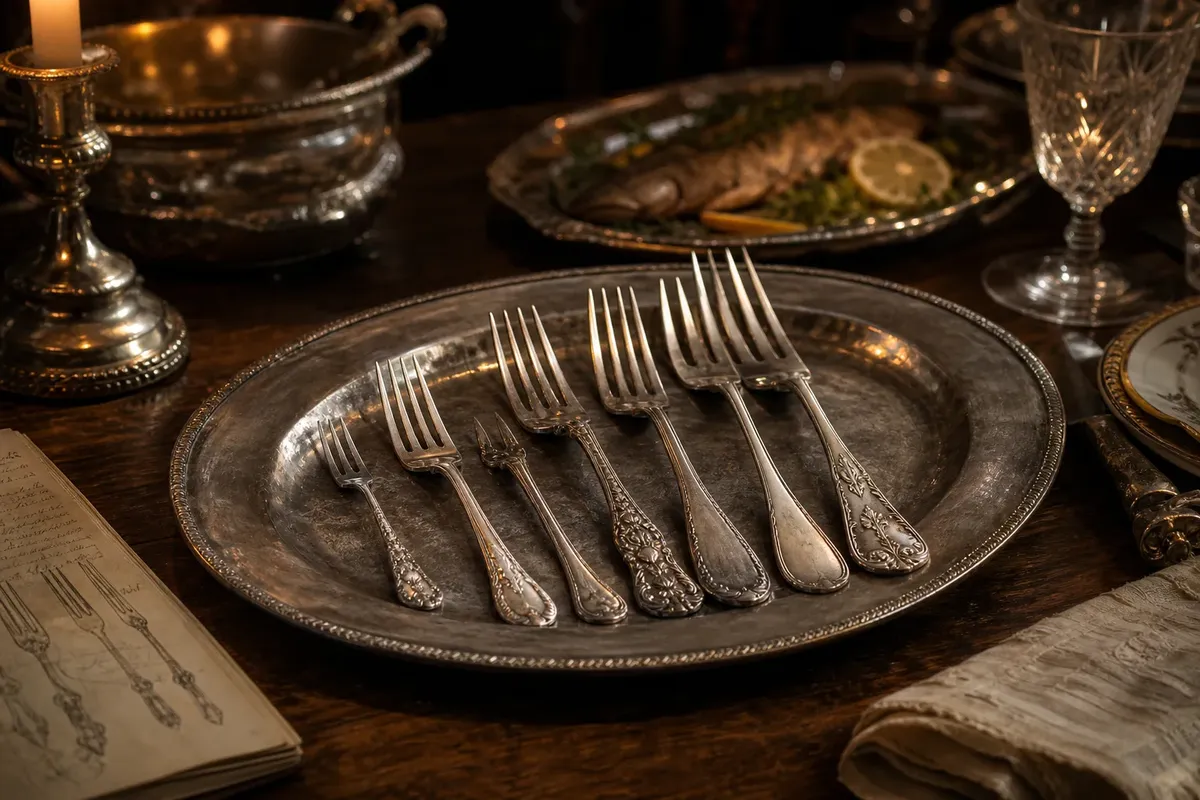
The common mistake is to treat an old fork as a smaller version of the one beside a modern dinner plate. The fork’s changing place at the table reflects shifting ideas about who handled food, how meals were served, and what counted as good manners.
Start with the setting, not the prongs. A fork might transfer food from a shared dish, serve a particular course, or let one diner eat from an individual plate; its material and companions can help distinguish those roles.
Shared table customs
In many European settings before personal forks became familiar, diners relied on fingers, knives, and spoons. A knife could cut food and help carry it to the mouth, while bread might be used beneath meat or its juices. Forks existed, but their presence did not make them routine utensils for every diner.
Some forks were used for serving or for particular foods. That limited role fits a meal in which people shared dishes and eating with the fingers remained accepted. The fork did not simply wait for a better design; its place depended on changing table habits.
When examining an early fork, ask what its form could do and where it belonged. A short handle or a small number of prongs may suggest a particular task, but neither feature establishes a date or use on its own. Provenance, local custom, and related objects matter.
Elite dining customs
Fork use spread unevenly among European elites over the centuries. The timing differed across regions and households, so it is safer to describe a gradual, varied change than to assign one moment when Europeans adopted forks. Italian dining customs form part of this history, but they do not account for every local path.
As personal forks gained acceptance in some settings, diners could handle food with less direct contact. The change also made the individual place setting more visible: a diner’s fork sat alongside a knife, spoon, plate, and drinking vessel. A fork could communicate refinement as well as practical use.
Silver can indicate that an object belonged to a valued table, but it cannot establish who used it or how many diners had one. A silver serving fork and a personal eating fork might both appear at an elite meal while serving quite different purposes.
Courses and specialized forks
As dining conventions developed, some households used separate forks for particular foods or courses, including fish or dessert. The forms and customs varied, and not every household adopted the same arrangement. A specialized fork makes the most sense in a setting that organized meals around distinct courses.
A fish fork, for example, belongs to a dining convention that treats fish as a distinct course with its own service. At a less formal meal, that distinction might not be useful. The growing variety of forks records particular choices about dining, not a universal requirement for every table.
Think of a place setting as a drawer of labeled keys: several may fit the same lock, but each label reflects a particular habit of use. When identifying a fork, compare its proportions, prongs, decoration, and companions rather than assuming that every difference marks a new era or a fixed course.
Evidence for identification
Use the object and its context together. Check these details, then choose the cautious interpretation that the evidence supports:
- Head size and shape: If the head is small or narrow, consider a specialized use; if no related utensils support that reading, describe the shape without assigning a purpose.
- Overall scale: If the fork is noticeably larger than eating forks beside it, consider serving use; if its size is comparable to personal utensils, keep both serving and eating possibilities open.
- Prongs and spacing: If the prongs suit lifting or spearing a particular food, note that possibility; if the evidence is ambiguous, avoid naming a specific food.
- Matching decoration: If the pattern matches other pieces, compare their forms and roles; if it does not, treat the fork as a possible addition rather than proof of a complete set.
- Associated utensils: If related course or serving pieces are present, use them to support a likely table role; if they are absent, state that the context is incomplete.
- Marks and provenance: If marks or ownership records can be checked against a reputable silver reference or specialist, use them as dating evidence; if they remain unclear, leave the date open.
Say you find a silver fork with a narrow head beside a group of broad dinner forks. You compare its prongs and decoration with the other pieces, then notice that one matching narrow utensil is recorded as part of the same set. That context makes a specialized course fork a reasonable interpretation; if there were no matching pieces or records, the more accurate description would be a silver fork with a narrow head and uncertain use.
Questions about silver forks?
Why did personal forks spread unevenly?
Many diners already used fingers, knives, and spoons, so a personal fork was not essential to familiar table customs. Its acceptance varied with local habits, social expectations, and the growing role of individual place settings.
When did forks become ordinary utensils?
There is no single date that applies to every region or household. Forks became familiar at different times, so an object’s setting and provenance are more useful than a broad label such as “medieval” or “early modern.”
Why do silver forks have different forms?
Some diners and hosts used specialized utensils for particular foods, courses, or serving tasks. Other meals required fewer distinctions, so a varied collection does not mean every table used every type.
Can a fork’s shape establish its date?
Shape can offer clues, but it rarely establishes a dependable date by itself. Compare construction and decoration with marks, provenance, and related pieces, and leave the date uncertain when the evidence is thin.
Context before claims
The fork’s changing place at the table becomes clearer when you ask who handled the food, whether diners shared dishes, and whether a meal called for separate courses. A silver fork carries clues in its form, but its companions and documented history can tell you more than the prongs alone.
If you are recording an inherited or collected piece, note its marks and which utensils were stored with it before assigning a date or function. For understanding the fork’s changing place at the table, that modest record is often more useful than a confident guess.
Look at this next
Why Silver Tarnishes Without Being Damaged
Why silver tarnishes without being damaged: learn to assess a darkened surface, distinguish tarnish from wear,…

Hammered or Smooth Silver: How Each Finish Shapes Light
Compare hammered and smooth silver finishes by the way they catch light, then use a simple…