Hammered or Smooth Silver: How Each Finish Shapes Light
Compare hammered and smooth silver finishes by the way they catch light, then use a simple viewing routine to choose an object that suits its setting.
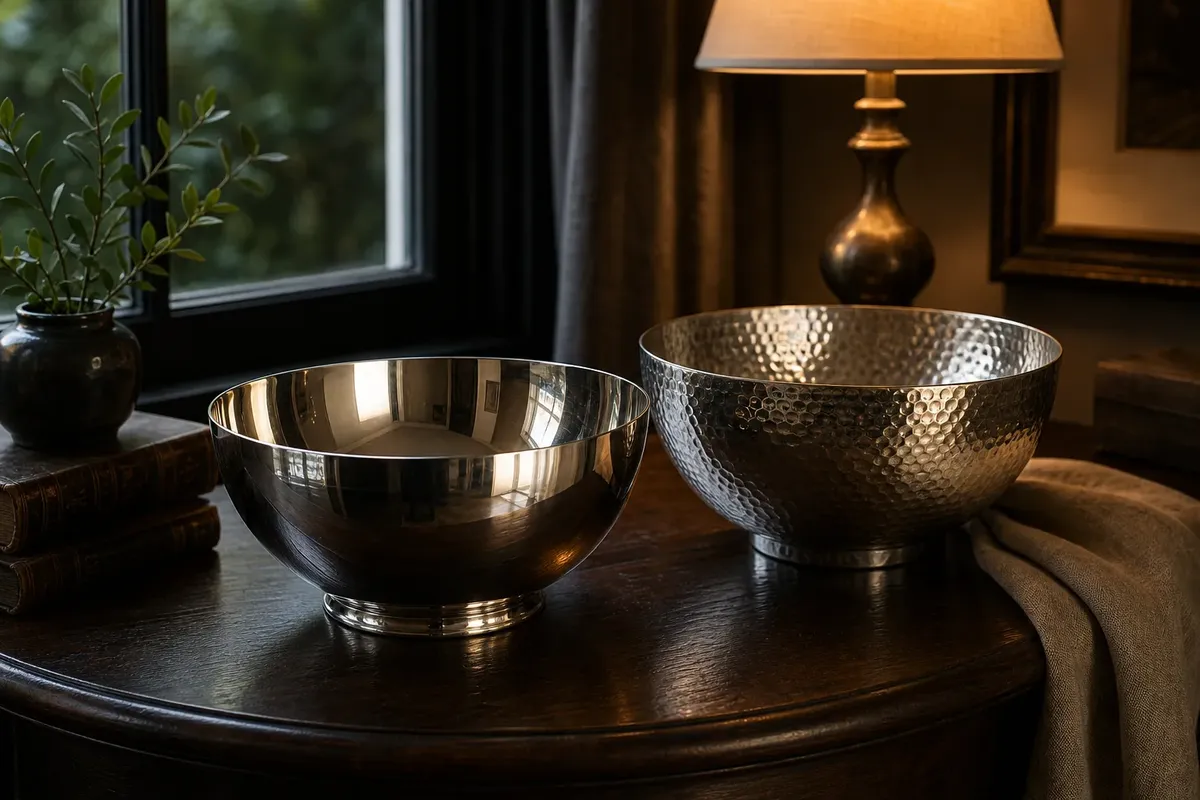
The common mistake when choosing a silver finish is judging it from one photograph or under one bright lamp. That can make hammered silver look busy or smooth silver look flat, and the wrong impression may steer you toward an object that feels out of place in your room. A short viewing routine helps you compare how each surface handles light before deciding.
Read the surface
A smooth silver finish presents a relatively even plane. Light reflects across it in broad, continuous shapes, so a window, candle, or nearby object may appear as a recognizable reflection. The result can feel quiet and crisp, especially when the object has a simple outline.
A hammered finish is shaped with repeated blows that leave small facets or shallow marks. Each change in angle redirects light, breaking a single reflection into a shifting pattern. The surface can seem lively, textured, or softly sparkling, depending on the depth and regularity of the marks.
Neither finish is automatically brighter. A smooth plane may produce a strong flash when it faces a light source, then look subdued when it turns away. Hammer marks may scatter highlights over a wider area, but their effect depends on the shape of the object and the direction of the light.
Think of the difference as a clean window beside rippled water: one gives a more legible reflection, while the other disrupts it into moving shapes. Silver is more complex than either analogy, but the comparison is useful when you want to describe the visual choice plainly.
Set a viewing routine
Use several days to see how a finish behaves in the places where the object might live. You do not need special equipment; a window, a table, and a lamp are enough. Keep the object stationary while you change the light, then rotate it gently to see how its angles alter the reflection.
- Day one, choose the setting. Pick the shelf, dining table, desk, or display cabinet where you expect to place the object. Notice the wall color and nearby materials, such as pale linen, dark wood, glass, or ceramic.
- Day two, check window light. Look at the object in daylight from the position where it will sit. Observe whether the smooth surface reflects a clear window shape or whether a hammered surface breaks that shape into smaller glints.
- Day three, check indoor light. View both finishes beneath the room’s usual lamp. A directional bulb can create sharp highlights on a smooth surface; a hammered surface may spread those highlights into a more varied pattern.
- Day four, change your distance. Look from across the room, then from nearby. Texture may read clearly at close range and blend into an overall sheen from farther away.
- Day five, consider neighboring objects. Place the silver beside the materials it will share space with. Decide whether the finish should stand out as a focal point or sit quietly among other reflective surfaces.
- Day six, compare angles. Turn the object a little at a time while keeping the light source fixed. Notice where reflections gather, where they disappear, and whether the changing pattern suits the object’s shape.
- Day seven, make the choice. Return to the setting you chose first and view the object under its ordinary light. Select the finish whose appearance feels right there, rather than the one that looked most striking in a single view.
Match finish to form
Start with the object’s silhouette. A smooth finish can emphasize long curves, clean edges, and carefully balanced proportions because the reflection follows the form without interruption. It often suits an object whose shape is meant to carry most of the visual interest.
Hammered texture adds another layer for the eye to read. On a broad bowl or shallow tray, marks can create a shifting field of highlights. On a narrow handle or small ornament, the same treatment may appear more subtle because there is less surface to catch the light.
Consider how much visual activity is already present. An object with engraved lines, pierced areas, or a complex outline may have plenty to show without a textured finish. A simple form can make room for hammer marks to become the main detail.
Scale matters as well. Fine, closely spaced marks can read as a soft shimmer at ordinary viewing distance, while deeper or more widely spaced impressions look more pronounced. If you are choosing from photographs, ask for a close view and a view at normal room distance; a close-up alone can exaggerate texture.
Choose for the room
Think about the room’s existing reflections. Glass, polished stone, and glossy furniture already create crisp highlights, so a smooth silver object may echo that order. A hammered piece can introduce a more varied surface among those reflections, though it may also draw more attention.
In a room with matte wood, woven fabric, or softly painted walls, either finish can work. Smooth silver provides a clear contrast against quiet materials. Hammered silver can connect visually with their irregular textures without needing to match them exactly.
Also consider the object’s role. If it should recede until needed, a calmer surface may be preferable. If it is intended to act as a sculptural accent, a more active texture can help it remain noticeable as the light changes.
Questions about silver finishes?
Does hammered silver look brighter?
Not in every setting. Its facets can create many small highlights, while smooth silver can return a stronger, clearer reflection when angled toward a light source.
Does smooth silver show reflections more clearly?
Usually, a broad, even surface makes reflected shapes easier to recognize. The clarity still depends on the object’s curvature, the surrounding light, and what stands nearby.
Can I judge a finish from a product photo?
A photograph can show the general character, but its lighting and camera angle may make either finish look more dramatic than it will in your room. Ask for images in both close and ordinary views, and compare them with the light where you plan to place the object.
Can a single object combine both finishes?
Yes. A maker may use a smooth area beside a hammered one to distinguish a rim, handle, or central panel. The contrast can clarify the object’s form, so look at where the transition falls and whether it appears deliberate.
Picture the object at home
Say you are choosing between a smooth silver bowl and a hammered one for a dark wooden side table beside a window. You set each option near the table at different times of day: the smooth bowl returns a clear patch of window light, while the hammered bowl breaks it into scattered highlights. If you want the bowl to reflect the room, the smooth surface may suit your preference; if you want texture to catch the eye, the hammered one may fit better.
Make the choice by asking what the surface should do in its setting: clarify the object’s shape, add texture, reflect nearby forms, or provide a changing glint. The best comparison of hammered or smooth silver is the one made under the light the object will actually share, with enough distance to see how it belongs in the room.
Look at this next
Why Silver Tarnishes Without Being Damaged
Why silver tarnishes without being damaged: learn to assess a darkened surface, distinguish tarnish from wear,…
The Fork’s Changing Place at the Table
The fork’s changing place at the table reflects shifting dining customs. Learn how to read silver…