Sterling Silver vs Silver Plate: What the Surface Can Tell You
Sterling silver vs silver plate differs in construction. Learn how body, surface and wear clues help you describe an object carefully and choose what to check next.
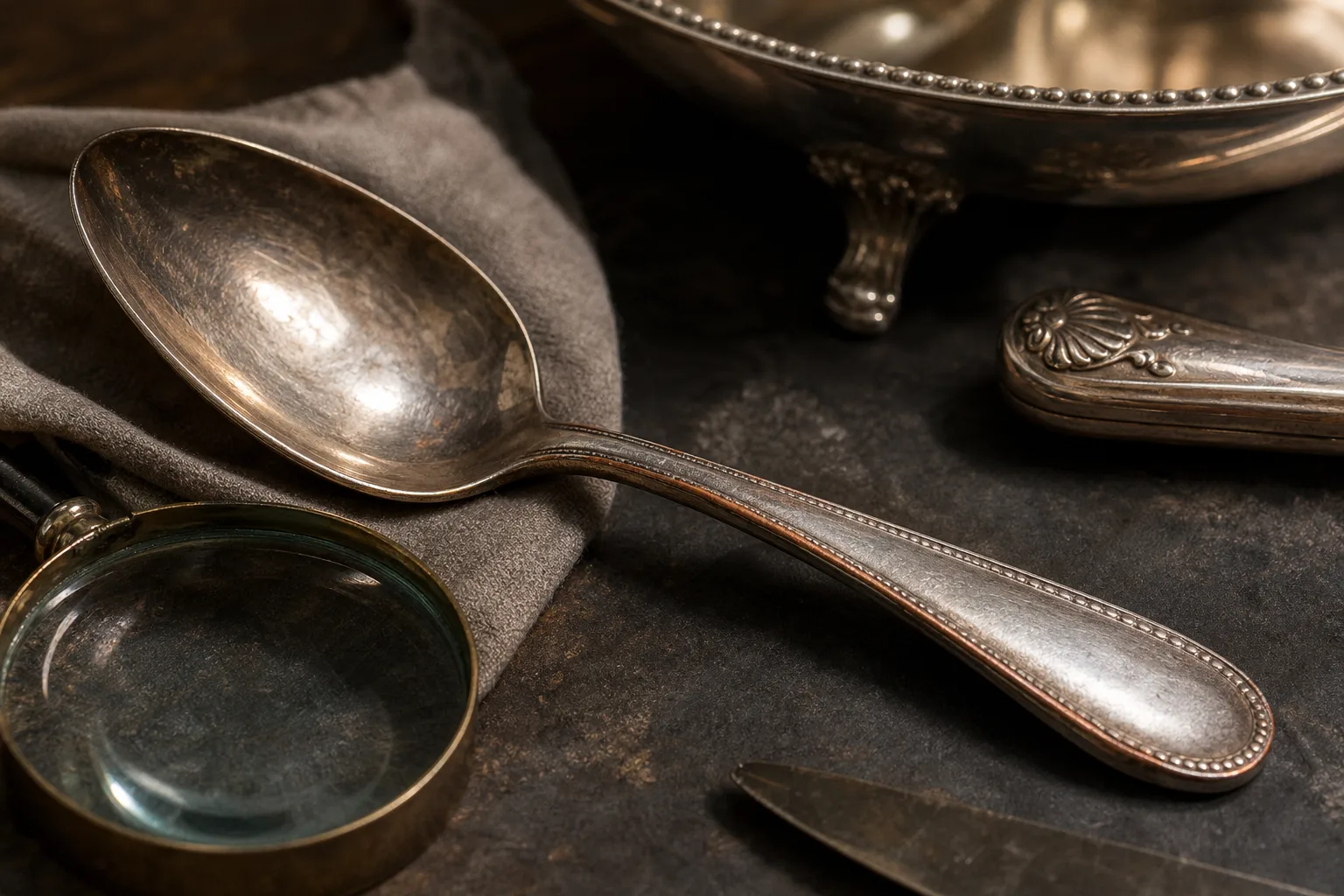
Sterling silver vs silver plate is a distinction in construction: one has silver alloy throughout its metal body, while the other has a silver layer over a different core. That difference affects how an object is made and how wear may appear, but does not by itself reveal its age, workmanship or history.
Colour can make the two look alike, especially on a polished table. To describe an object carefully, consider its material structure, the way its parts are assembled and any changes at exposed edges. Treat each clue as evidence with limits, not as a verdict.
Silver body and coating
Pure silver is relatively soft for many everyday uses, so silver objects are often made from an alloy: silver combined with other metals. Sterling silver is a recognised silver alloy, with its fineness convention varying by jurisdiction. In Britain, the term is associated with a legally defined fineness standard; a silver-coloured surface or informal label alone does not establish that an object meets it.
Silver plate has a different structure. A thin silver layer covers a base made from another material. Depending on the object and its manufacture, that core may be copper, brass, nickel silver or another alloy. Nickel silver contains no silver despite its name; it is a copper-based alloy that can be used beneath a plated surface.
- Sterling silver: silver is present throughout the alloy body.
- Silver plate: silver forms a surface layer over a different core.
- Silver-coloured metal: a pale alloy may have no silver layer at all.
Plating is a construction choice, not a verdict on an object’s workmanship. A plated surface can carry crisp detail, while its core influences how the object is shaped and assembled.
Construction clues
Look at edges, corners, raised decoration, handles and joints. These areas may meet more contact than a protected panel, so a plated layer can wear there first. A differently coloured patch may reveal the base, but solder, repairs, tarnish, dirt and reflected light can produce similar visual changes.
Compare the location and shape of a colour change with nearby protected areas. A line along an exposed handle edge may fit a wear pattern; an isolated patch may have another explanation. Avoid rubbing or scraping it to find out.
Assembly also matters. A seam, joint or separate fitting can reveal how an object was put together, but not whether its main body is sterling or plated. Components such as a blade, handle and decorative fitting may use different materials.
A magnet is not a reliable way to separate sterling from plate. Silver and several common plating-base metals are not attracted to an ordinary magnet, while a steel component may respond even if the rest of the object does not. A response therefore concerns the part being tested, not necessarily the whole object.
Marks and making
Marks can offer more specific evidence than general appearance, but their meaning depends on the marking system and the object’s context. On a spoon, inspect the back of the handle and underside of the bowl; on a tray, look at the base and rim. Use diffuse light or a magnifier, and turn the object to view a mark rather than rubbing it.
A group of punches may include a standard mark and a maker’s mark. A word or abbreviation may instead identify a plated process, maker or pattern. “EPNS” commonly refers to electroplated nickel silver: a nickel-silver base with a deposited silver surface. Marks can be worn, incomplete, imitated or governed by conventions from another place or period, so an unfamiliar mark—or no visible mark—does not settle the composition.
For a materials assessment, the useful question is not only “What do these marks say?” but “How does the marked part relate to the object’s visible construction?” A mark on one fitting may not describe every component. Keep the material description distinct from any attribution about maker, date or place.
Evidence and decisions
Separate observation from interpretation. “Copper-coloured line at the handle edge” describes what is visible; “silver-plated” is an inference that may need confirmation. This distinction makes a description more useful to a conservator, dealer or specialist.
- Check the body and fittings separately. If they appear to have different construction, describe each part; if the join is unclear, leave the relationship unresolved.
- Check edges and raised areas for colour changes. If a change follows an exposed edge, note possible wear; if it is isolated, consider repair, dirt or another cause.
- Check protected areas against exposed ones. If their surfaces differ, record both locations; if they look alike, treat that as inconclusive rather than proof of sterling.
- Check seams and joints without probing them. If a join aligns with a colour change, note that assembly or repair may explain it; if no join is visible, do not assume the surface is original.
- Check marks in good light. If a mark is legible, record its position and wording; if it is partial, preserve the uncertainty and do not expand it from memory.
- Check photographs for context and detail. If a close view shows the feature clearly, keep it with a full-object image; if it does not, describe the feature as unclear and seek another view.
Use several kinds of evidence together, while keeping their limits visible. A recognised standard mark read in context is more specific than colour alone. A plating mark or exposed base metal can support a description of plate, but a repair or mixed construction may complicate it.
Say you inherit a serving spoon with faint punches and a copper-coloured line along one handle edge. You note the starting observations as “silver-coloured body, faint marks, copper-coloured edge line” and photograph the spoon in diffuse light, including the back of the handle and the bowl’s underside. In the photographs, the line follows the exposed edge, but the punches remain unreadable. The resulting description is “silver-coloured serving spoon with possible edge wear; material undetermined”. The line supports a possible plating interpretation, while the incomplete marks and unexamined construction leave that conclusion open.
What can appearance establish?
Can colour identify sterling silver?
No. Tarnish, lighting, polishing and the metal beneath a plated layer can all affect colour. Use it as a clue to compare across the object, not as proof of composition.
Does exposed copper prove an object is plated?
It suggests that another metal may lie beneath the visible surface, but it does not identify every component or rule out repair. Record where the colour appears and keep the material conclusion provisional if it matters.
Can a magnet distinguish sterling from plate?
Not reliably. Sterling and many common base metals are not attracted to an ordinary magnet, while a separate steel component may respond.
What should you do with unclear marks?
Photograph them in clear light and record only what is legible. A qualified silver specialist can assess uncertain marks and construction, while explaining the limits of the opinion.
When to seek assessment
If marks and construction clues point in the same direction, describe the evidence precisely, such as “marked sterling” or “silver-plated, with wear at the rim”. If the object is unmarked, altered or especially important to you, ask a qualified silver specialist to assess it.
Avoid scraping, filing, applying chemicals or cutting into the object yourself. These actions can damage the surface or change the evidence. Before agreeing to an examination, ask what method is proposed, whether it could alter the object and what the result can establish.
The most useful account of sterling silver vs silver plate keeps material, surface condition and assembly separate. A clear note about what is visible—and what remains uncertain—gives the next person a sounder basis for describing the object.
Related reading
A Hallmark Is a Clue, Not a Complete Biography
Learn how to read a silver hallmark by recording each mark, comparing interpretations and deciding when…

Why a Spoon’s Bowl Changes Shape
Why a spoon’s bowl changes shape, and how outline, depth and handle proportions help you choose…