A Hallmark Is a Clue, Not a Complete Biography
Learn how to read a silver hallmark by recording each mark, comparing interpretations and deciding when an uncertain identification needs specialist review.
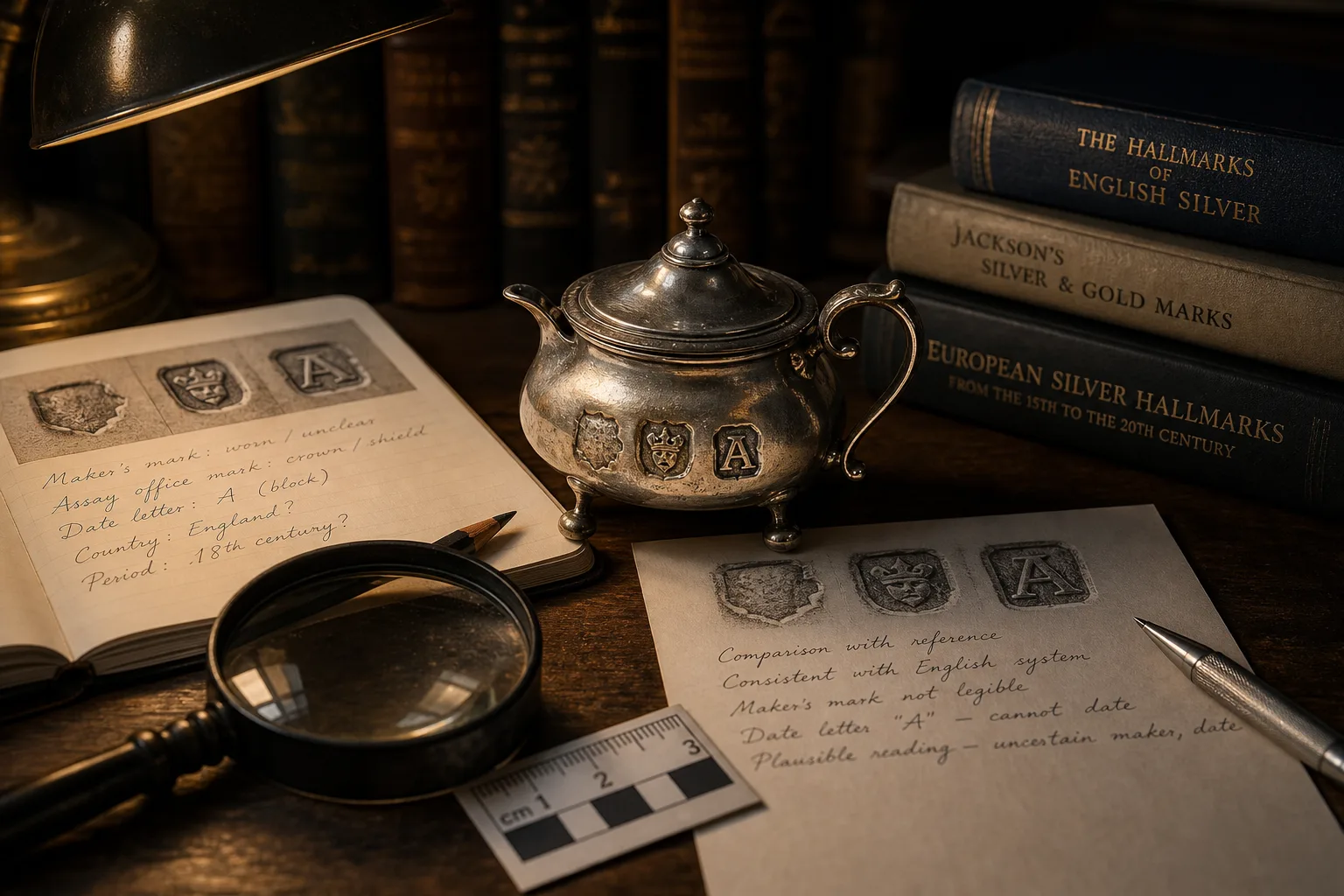
A silver hallmark is best read as a group of clues, not as a complete biography of an object. To read a silver hallmark responsibly, record what you can see before deciding what the marks mean: a maker’s stamp, a fineness mark, an assay office symbol and a date letter may answer different questions, but the set varies by country and period.
Record visible marks
Start with the object in ordinary, even light. A desk lamp placed to one side can reveal shallow impressions without the glare of a direct flash. Use a magnifying glass if needed, and take a close photograph with a scale beside the marks. Do not clean or polish the area first; abrasion can soften details, and residue may be mistaken for part of a stamp.
Describe each mark as it appears. Note its position, outline, orientation and legible characters. If a letter could be either an I or a J, record both possibilities rather than choosing one. Keep the marks in their physical order, but do not assume that order alone establishes their meaning.
Separate what you see from what you infer:
- Observation: “A small shield-shaped stamp contains a crown-like device.”
- Possible reading: “The device resembles an assay office mark in a particular system.”
- Supported identification: “A reference for the relevant country and period matches the legible mark and its context.”
Keep observations and interpretations in separate notes. That makes it easier to amend a reading when better evidence appears.
Compare the whole group
Begin by establishing where the object may have been made or assayed. Its form and construction can offer context, but neither proves a place of origin. Then consult a reputable reference specific to the country and period you are considering; hallmarking systems and rules have varied, so a symbol should not be read in isolation.
A maker’s mark, fineness mark and assay office device may help narrow possible readings when they are considered together. A date letter can be especially difficult: its meaning may depend on the letter’s font and case, the outline around it, the other marks and the relevant local cycle. Do not assign a date from a letter shape alone, or assume that a familiar symbol has the same meaning in every system.
Say you inherit a small silver mustard pot. For this invented example, assume its maker’s stamp is worn, while two other marks are clearer. You photograph all three, record the maker’s characters as uncertain, and compare the clearer marks with a reference for the country suggested by the pot’s form. If those marks appear consistent with that system but do not identify a unique date, the resulting note can say that the reading is plausible while leaving the maker and date unresolved.
A resemblance is a lead to check, not confirmation.
Choose a reading method
Visual recording
Photographs, a sketch and literal descriptions preserve the evidence without claiming an origin or date. This is a sound first approach when impressions are faint, crowded or partly obscured. Its limit is simple: recording a symbol does not identify it.
Reference comparison
A specialised book, museum resource or established hallmark database can help when the marks are legible and the relevant country and period are reasonably clear. Compare the full group, and check that the reference describes the same marking system. An imported, altered or re-marked object can complicate the reading, so note any conflict rather than forcing a match.
Specialist review
When an attribution matters for a sale, insurance record or family history, ask an appropriately qualified silver specialist to assess the marks alongside the object’s form, construction and wear. An experienced dealer, auction-house specialist, assay office or museum curator may have relevant expertise, though the scope of their advice can differ. Ask which parts are confirmed and which remain uncertain.
Questions about hallmarks?
Does a fineness mark identify the maker?
No. Depending on the marking system, a fineness mark indicates a claimed or regulated standard for the metal; it does not by itself name the maker. Read it with the other marks and the object’s context.
Can one symbol date a silver object?
Usually, a symbol must first be identified within a particular marking system before it can help with dating. A date letter may recur in different cycles, so its form, surrounding marks and local context matter.
What if a mark is too worn to read?
Record the visible outline and surviving strokes, then photograph the area without altering it. If the identification matters, ask a specialist to inspect the object rather than filling in missing characters from expectation.
Do matching marks prove every part is original?
No. Repairs, replacements and later additions can complicate what a group of marks indicates. Treat originality as a separate question and compare the construction and wear with the claim being made.
Keep claims proportionate
Use careful wording in catalogues, family notes and sale descriptions. “Stamped with a mark resembling…” reports an observation; “attributed to…” signals a provisional interpretation; “identified as…” should be reserved for a conclusion supported by relevant evidence. Keep photographs of both the marks and the whole object, since context can help make a comparison more meaningful.
When you read a silver hallmark, a useful record shows what was visible, which country- and period-specific references were consulted, and what remains uncertain. If the evidence does not support a firm date or maker, preserving that uncertainty is more informative than supplying a neat but unsupported answer.
Related reading

Why a Spoon’s Bowl Changes Shape
Why a spoon’s bowl changes shape, and how outline, depth and handle proportions help you choose…
Sterling Silver vs Silver Plate: What the Surface Can Tell You
Sterling silver vs silver plate differs in construction. Learn how body, surface and wear clues help…